Midjourney’s Scanner
👋🏼
Slowly changing physics of Ultrasound scanning is exciting
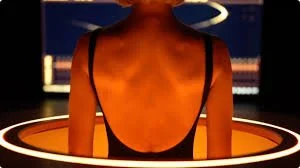
If you watch it as a technology announcement, you're watching an imaging demonstration. If you watch it as a designer, you're watching a form language decision and the decision is more deliberate for being a render. No physical prototype required. What they published first was the experience, not the machine.
Most imaging hardware announces its constraints in the object itself. The closed bore of an MRI machine needs you horizontal, enclosed, still, for the duration. The handheld ultrasound probe says: this machine needs a trained operator's hand pressed against your skin. The Midjourney Scanner machine is willing to work around you.
That shift is exciting and what makes this announcement worth examining.
Traditional transducer arrays image a partial cross-section from a single contact point. The operator's hand pressing the probe against the patient's skin isn't a UX preference, it's the imaging physics. Operator dependency is a product of the physics, not a choice layered on top of it.
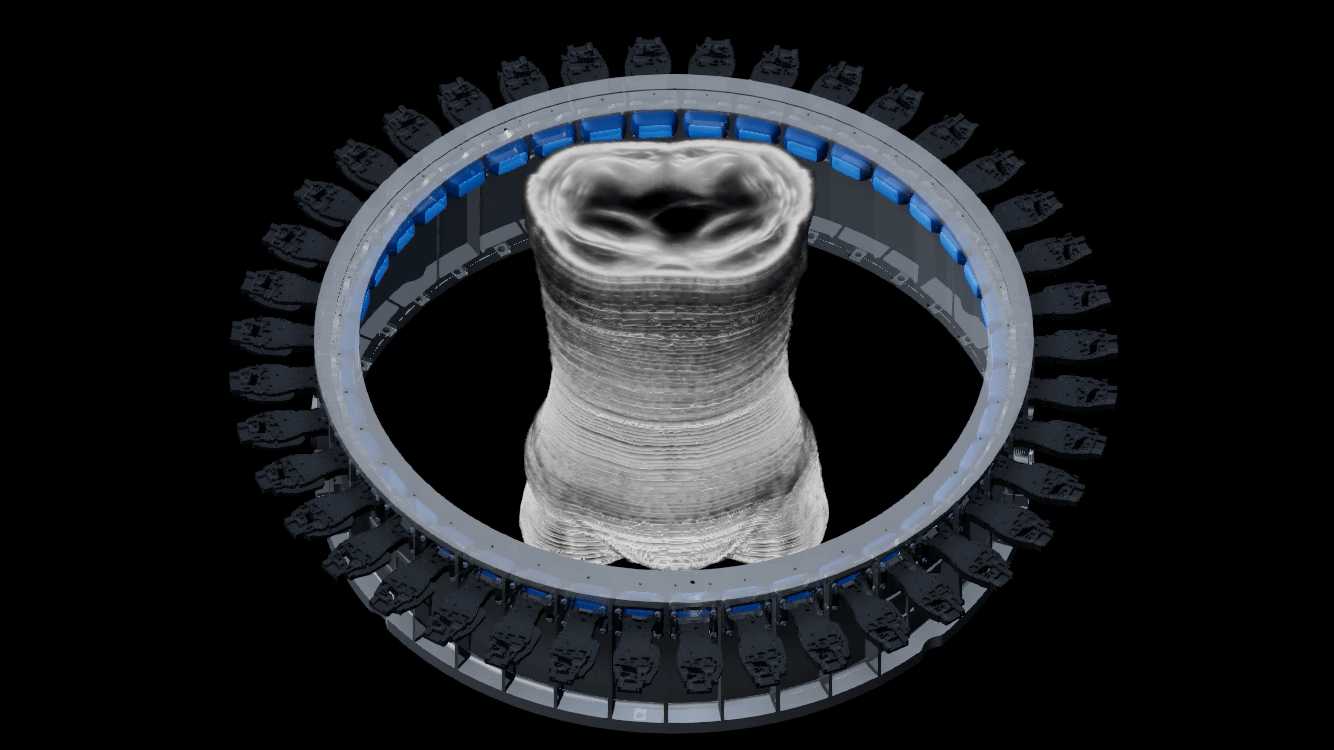
What the Caltech group's 2026 paper in Nature Biomedical Engineering describes is a change to the physics. A 512-element circular receiver array combined with a rotating single-element transmitter generates whole cross-sectional ultrasound imaging without any contact point and without any operator. Sequential scans show strong agreement with clinical MRI counterparts. The paper is an acoustics document, not a design document. But it matters to a designer because it dissolves a constraint. Midjourney's commercial prototype uses 40 Butterfly Ultrasound-on-Chip modules arranged in a ring, each chip carrying 8,960 transducers at 200 microns wide, fabricated directly onto CMOS silicon. Butterfly's approach replaced the piezoelectric crystals that have defined ultrasound hardware for decades with capacitive micromachined transducers built on the same substrate as computer processors — a different category of manufactured object, opening different hardware geometries.
Marine biologists studying manta ray reproduction arrived at the same acoustic principle years earlier. By holding an ultrasound probe 4-5 centimetres above a ray's skin, underwater, researchers let the surrounding water carry the sound between scanner and body — no contact, no gel, no disturbance to the animal. Froman et al.'s 2023 paper in the Journal of Fish Biology confirmed that this contactless underwater approach could reliably image internal anatomy and detect pregnancy in manta and devil rays without touching them. The acoustic reason is the same one the Midjourney immersion tank is built on: water transmits ultrasound with minimal attenuation and no air-gap interference, doing exactly what conductive gel does in a clinical handheld probe. When the body descends into the tank, the water becomes the coupling medium between the 40 Butterfly chip modules arranged in the surrounding ring and the tissue they're imaging — making contact pressure unnecessary, and making a full-ring geometry with no single operator point of view physically possible.
When the transducers form a full ring and the patient moves through it, the contact-point constraint disappears. With it goes operator dependency, the horizontal supine position, and the 30-to-90-minute dwell time that shaped the acoustic and spatial design of every MRI suite.
The medical device design community has known for decades that the clinical environment excludes users. The dominant response has been to improve devices for that environment — wider bores, acoustic dampening, shorter sequence times. These are genuine improvements. They also accept the clinical environment as fixed and work within it. What Midjourney is proposing is a different context entirely. The spa is not a better hospital room. It's a design argument that the clinical environment is optional, that someone who wants to know what's happening inside their body doesn't have to become a patient to find out.
The back end of the Midjourney Scanner is in the same position. Medical imaging has always had a designed front end. What it has never had is a designed interpretation layer addressed to the person the imaging is actually for.
Wang, L. V. et al. (2026). Whole cross-sectional human ultrasound tomography. Nature Biomedical Engineering. https://doi.org/10.1038/s41551-026-01660-4
Hammerand, J. (2026, June 18). What Butterfly's saying about Midjourney's ultrasonic CT plans. Medical Design & Outsourcing. https://www.medicaldesignandoutsourcing.com/midjourney-ultrasonic-ct-butterfly-network/
Midjourney. (2026, June 18). A new era of Midjourney [Blog post]. https://www.midjourney.com/medical/blogpost
Iacobucci, G. (2026, June 22). "Full body ultrasound" — AI firm Midjourney pivots from image generation to launch rival health scans. BMJ, 393. https://doi.org/10.1136/bmj-2026-100053