Patches and lines
👋🏼
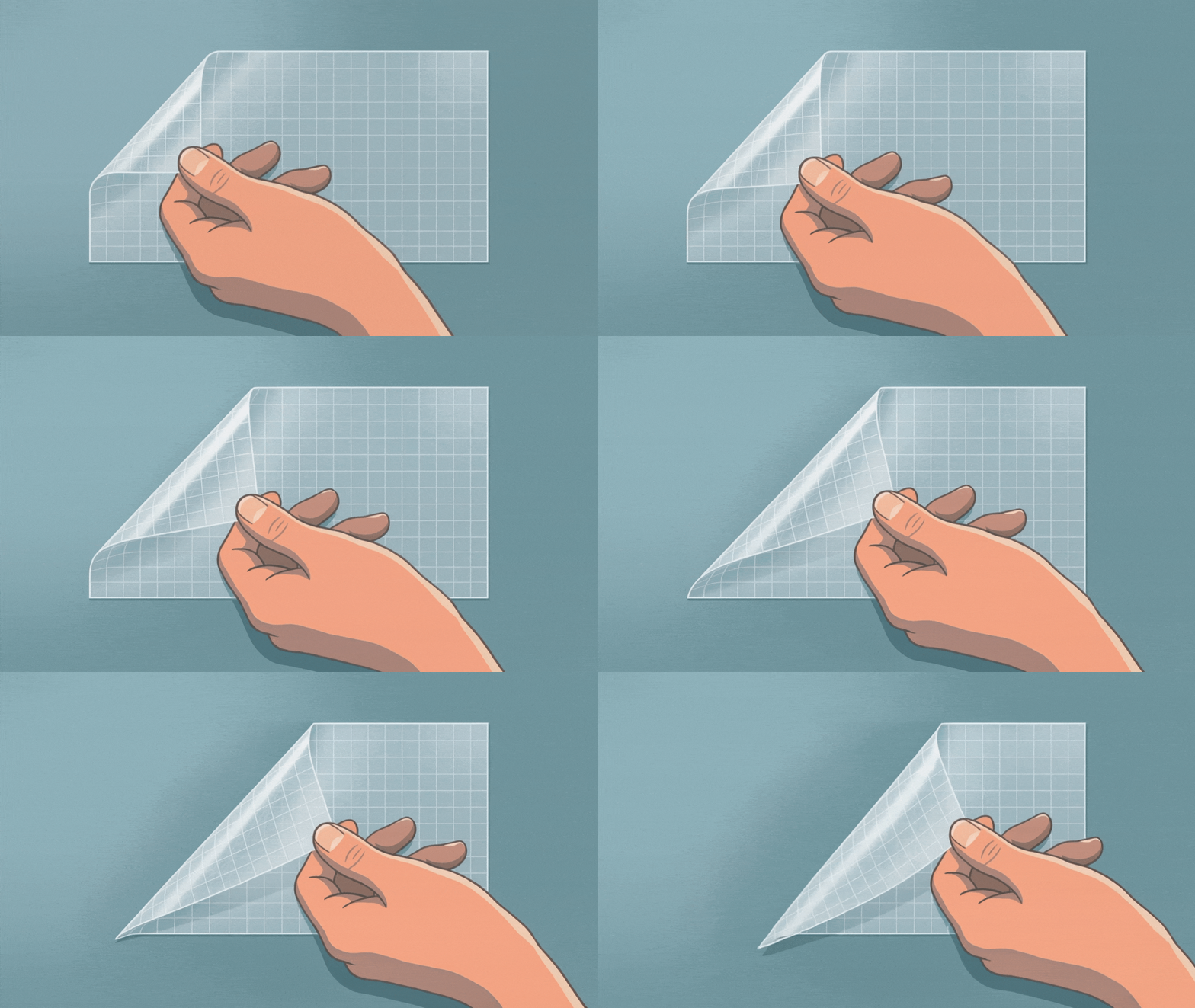
Surface finish limitations of an adhesive material.
also, Vizcom’s coming handy to make these gifs now!
In a 7-day wear study, 30 volunteers wore adhesive patches on the lower torso, some carrying flexible circulatory, some carrying only the adhesive stack meant to hold a sensor in place. By day 4-5, their patches had begun falling, not lifting evenly from one edge, not curling at a corner, but delaminating in a series of parallel horizontal stripes, evenly spaced, running across the width of the patch like a hatch pattern the material itself hadn’t been designed to produce.
The stripes were matching (almost matching) the direction of Langer Lines-the natural lines of tension in human skin, mapped by anatomists more than a century ago. On the lower torso, those lines run roughly horizontal, so did this failure pattern running in the same direction. (Stuart et al., 2024). The patch design did not account for this neither the printed circuit referenced the skin direction.
The circuitry underneath did not fail this way. Stretchable sensor design has an established solution for surviving strain. Rigid islands hold the electronics and the kirigami patterned metal trace absorbs the strain of the chip. The geometry distributed strain into the bend of the trace rather than concentrating it at a rigid point.
In the 7-day experiment, this help but the adhesive failed. The patch with thickest adhesive, lift off by the day 5 and the patch with the thinnest adhesive, remained fully attached on the volunteers through day 7 and this received the engineering attention. The adhesive did the harder job of negotiating with surface that moves, sweats and replaces its own cells every one of 2 weeks.
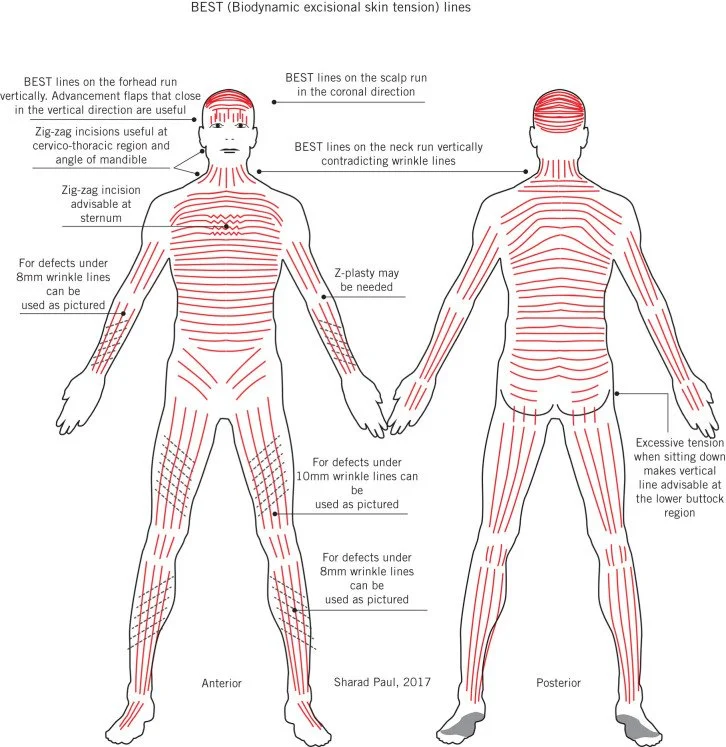
Biodynamic excisional skin tension lines
The adhesive layer has a defined physiology to work against. Skin replaces its outer layer on a cycle of 7 to 14 days. A patch meant to stay attached for more than 2 weeks sits on surface that is over the same window, shedding itself, rebuilding itself, and producing moisture at a rate set by exactly where on the body it’s placed. Moisture vapor transmission rate and adhesive thickness are the 2 properties manufacturers publish to describe this interface. Both describe the tape alone, not the tape against the specific patch of the skin, at a specific body location which where the broken expectations lay. The one variable that could change how the patch geometry sat relative to the direction skin is the orientation of the skin’s natural pull at that location.
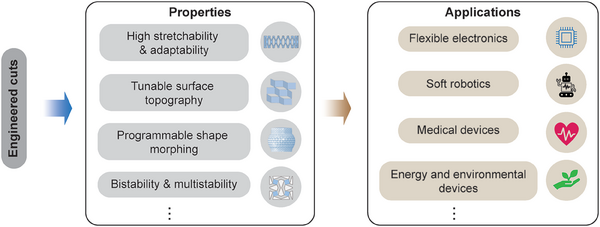
Vertical serpentine interconnect-enabled stretchable and curved electronics
Textile and product design treat directional material behavior as an after-thought. The wearable patch industry has not extended that discipline to the one surface every patch shape is actually sits on. Patch shape is selected for the sensor layout and interconnect routing but is left unspecified relative to body’s own tension lines. Serpentine and kirigami interconnect geometry exists because engineers considered “device will be stretched” as a design constraint worth solving. Langer lines describe a comparably predictable, mappable mechanical fact about the surface the device will get attached to and at the design stage it currently gets no equivalent. This is a fixable gap where body-location specific patch templates, oriented to known tension-line maps, would not require new materials. It requires orientation as a drafted specification like alignment mark that carries grainline, cutter axis, an anisotropic patch outline with different edge profile.
Continuous monitoring is moving forward towards 2 week to a month long wear, on populations that include aging skin, chronic patients, and locations far more varied. While the technology and engineering are considering these constraints the adhesive chemistry is still falling behind.
Lee, B., Cho, H., Jeong, S., Yoon, J., Jang, D., Lee, D. K., Kim, D., Chung, S., & Hong, Y. (2022). Stretchable hybrid electronics: Combining rigid electronic devices with stretchable interconnects into high-performance on-skin electronics. Journal of Information Display, 23(3), 163–184. https://doi.org/10.1080/15980316.2022.2070291
Stuart, S., de Kok, M., O'Searcoid, B., Morrisroe, H., Serban, I. B., Jagers, F., Dulos, R., Houben, S., van de Peppel, L., & van den Brand, J. (2024). Critical design considerations for longer-term wear and comfort of on-body medical devices. Bioengineering, 11(11), 1058. https://doi.org/10.3390/bioengineering11111058
“This article was researched and drafted with the assistance of AI tools, used for literature search, synthesis, and drafting support. All framing, analysis, and conclusions are the author's own. Sources are cited directly in text; AI tools are not listed as references.”